
SpaceX: A 41% Fall Does Not Make It Cheap

JPMorgan says SpaceX's shares are “a high-value acquisition currency.” Translated: the stock is expensive, and expensive stock is useful for buying things. Space Exploration Technologies · NASDAQ: SPCX · $135.27 · 16 July 2026

A month ago I wrote that SpaceX was probably a wonderful business, and definitely not at a fair price. The market has since agreed with me, and rather faster than I expected.
Though I should be careful how much credit I take for that. Some of the fall is the company. Some of it is that renewed conflict in the Strait of Hormuz pushed oil higher and drove money out of exactly the sort of share SpaceX is: high growth, no earnings, and a beta of 5.8x. A stock that moves nearly six times as much as the market will always be among the first things sold when the market takes fright. Which is itself worth noticing, and I will come back to it. That is a property of the price, not of…rockets.
I wouldn’t normally return to a company this quickly, however, two reasons justify it. The first is that the downward price is 41%, which is a large enough correction that the question genuinely deserves asking again — a fall of that size can turn an expensive stock into a reasonable one, and it would be lazy not to check. The second is that something new has appeared, which is more interesting than the fall. The sell side (brokers) has begun arguing that SpaceX should buy Tesla. The reason they give for it is the reason I am writing this, but also, this would create roughly a $3 trillion dollar combined company, putting it in P4 in the global ranks by market cap.
Saying the ‘market has agreed with me’ is an easy sentence to write, and I want to be careful with it, because it is also where most analysts stop. The shares peaked at $225.64 on 16 June — four days after the largest listing in history — and now sits at its low range, dipping below its IPO price of $135. That is a fall of about 41% in just over a month. Being right about a direction is easy.
The harder question, and the only one that matters now, is whether this drop has made this cheap. It has not. I want to show you why, and then show you the thing almost nobody has picked up, which is what the sell side is now quietly arguing this company is for.
What is genuinely good here
Start with the case for owning it, and make it properly. SpaceX has built something close to a monopoly in a hard business. It launches more mass to orbit than every other operator on earth combined, and it does so on reusable hardware nobody else has been able to replicate at scale. That is not a story. It is a decade of engineering that competitors have had every incentive to copy and have not managed to, which is the most durable kind of advantage there is — and precisely the sort of thing this newsletter usually spends its time looking for.
Starlink is more interesting still. It has passed ten million subscribers, it is the closest thing in the group to a real, recurring, cash-generating business, and it solves a problem — connectivity where cables do not reach — for the foreseeable future, that has no obvious substitute. If SpaceX were only Starlink and launch, we would be having a different conversation.
And the demand is real. The company has signed AI infrastructure contracts of a size that would flatter any balance sheet. I do not doubt the technology, the engineering culture, or the addressable market. It is the price.
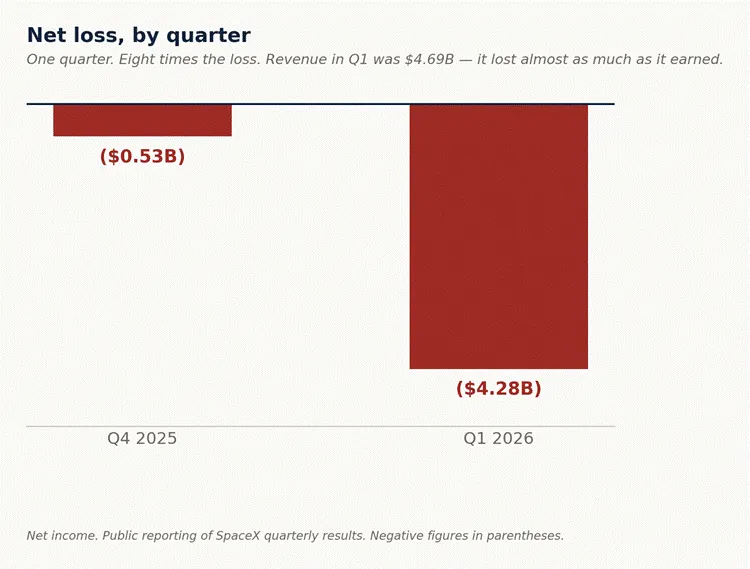
Not a bad quarter. A worsening trend.
In the first quarter of 2026, SpaceX generated $4.69 billion of revenue and lost $4.28 billion. It lost almost as much as it earned. In the quarter before, the loss was $528 million. So the loss did not merely persist — it grew roughly eightfold in three months.
There is a serious answer to this, and I want to give it its full weight, because it is the argument I would make if I were long.
Reported earnings can badly understate what a company is building. Accounting charges the cost of a data center against today’s profit, whether or not that data center goes on earning for the next twenty years. It front-loads the cost and defers the reward. So a company investing hard will always look worse on the income statement than it truly is — and will show its thinnest profits precisely when it is creating the most value.
Amazon is the proof. In 2025 it turned over $716.9 billion and threw off just $11.2 billion of free cash flow, down from $38.2 billion, because capital spending jumped $50.7 billion — a rise the company attributed primarily to investments in artificial intelligence. On its face, that looks broken. It is not broken. It is what Amazon has done for thirty years, and Jeff Bezos told shareholders in his first letter, in 1997, to judge the company on long-term cash flow rather than quarterly earnings. He was right, and the people reading the income statement were wrong.
So: is SpaceX simply Amazon, earlier?
No — and the reason is the whole argument.
Amazon was spending money it earned. Underneath the capital expenditure sat AWS: under a fifth of revenue, the majority of operating income, margins north of 30%. The retail flywheel threw off cash. The build was self-funded, out of $139.5 billion of operating cash flow. Strip away Amazon’s growth capital and you find an enormous cash machine underneath, temporarily hidden.
Strip away SpaceX’s growth capital and you find nothing underneath. There is no AWS here. There is no engine quietly paying for the build. The capital being spent is not cash the business generated — it is cash the business raised.
That is quite important. It is the difference between a company reinvesting its profits and a company spending other people’s money. The owner-earnings argument — the one that vindicated Amazon — requires earnings to reinvest from. SpaceX does not have any.
What it would have to earn

The price is the assumption. Everything else is detail.
At roughly $1.81 trillion, and applying a conventional twenty times earnings, SpaceX would need to generate about $96 billion of annual net income to be worth what it costs. Apple net income is approximately $100 billion. Alphabet and Microsoft are in the same territory.
So the price does not merely assume SpaceX succeeds. It assumes SpaceX becomes as profitable as the most profitable company in the world, and it assumes this while the company is currently losing money at an annualized rate of about seventeen billion dollars.
That is not a forecast I am able to make, and I have not seen anyone else make it either. What I have seen is a great deal of writing about the technology, and very little about the number the technology has to produce.
The market’s own uncertainty is instructive. Analyst price targets on SpaceX run from $62 to $310. That is a five-fold spread on a single, exhaustively covered, trillion-dollar company. It is not a forecast. It is a group of professionals telling you, in the only way their job permits, that they do not know.
Why the sell side wants SpaceX to buy Tesla
Here is the part that changed on how I read this company.
On 7 July, JPMorgan’s Rajat Gupta published a note on a possible SpaceX–Tesla merger, calling it “strategically coherent on paper.” The coverage fixed on the word coherent. I would point you at the reason he gave. Gupta named two things that make a deal possible, and the first, as reported by CNBC, was that SpaceX’s record IPO “furnishes a high-value acquisition currency.”
Say that in plain English. The reason SpaceX can buy Tesla is that SpaceX’s shares are expensive. Not that the two businesses fit. Not that the combination earns more than the parts. The stock is dear, and dear stock buys things.
That is not a synergy. It is an arbitrage — and it is not hypothetical.
SpaceX is already spending the currency. It is acquiring Cursor, the artificial-intelligence coding platform, and it is paying with roughly $60 billion of newly issued stock, with the deal expected to close in the third quarter. The structure has been reported as designed to reduce dilution if the share price rises — which is to say, the more expensive the paper, the cheaper the acquisition.

SpaceX Stock: Borrowed, listed, refinanced, and now issuing more stock.
Once you see it, the history rearranges itself.
In November 2021, Musk sent a company-wide email describing a crisis in Raptor engine production. “There is no way to sugarcoat this,” he wrote. And then, the sentence that got the attention: “We face genuine risk of bankruptcy if we cannot achieve a Starship flight rate of at least once every two weeks next year.”
They did not achieve it. And they did not go bankrupt.
They raised money instead. That is the answer SpaceX has given to every cash crisis in its twenty-four-year history, and it has always worked, because there has always been someone willing to fund the story. The $75 billion IPO is that same move at the largest scale anyone has ever attempted. The $60 billion of stock going to Cursor is the move again. A Tesla acquisition would be the move once more — except this time the thing being bought is not technology. It is cash flow.
Which is worth saying slowly. The company that cannot generate cash would be using its share price to acquire a company that can.
Set the two side by side. SpaceX trades at roughly 78 times its forecast revenue for this year, and about 141 times last year’s — some twenty-six times Amazon’s multiple. Tesla trades at about 15 times sales, and Tesla generates cash. RBC has modelled the deal as all-stock at a 20–30% premium, and I think that is about right: a Tesla shareholder is being asked to surrender positive free cash flow, accept paper in a business that has none, and pay a premium for it. Wanting compensation for that is not greed. It is the math’s.
None of which makes the deal a bad idea for SpaceX. It makes it an excellent idea for SpaceX. That is precisely the point.
The float nobody is talking about
One more structural fact, because it bears on every price in this article. Only about 4% of SpaceX’s shares actually trade. The lock-up releases in stages, and after the first set of results, pre-IPO holders become free to sell roughly 7% of shares outstanding — more than the entire IPO.
So the price that JPMorgan calls a high-value acquisition currency is being set by a very small slice of the company, and the supply of that slice is about to more than double. I do not know what that does to the share price. Neither, I would suggest, does anyone else. Watch this space.
What I have seen before
In my years in banking, I have watched a number of deals come across screen or from a phone call. I was not in the SpaceX syndicate, and what reached me was anecdote and murmur rather than anything I could verify. But the concerns were consistent enough to be worth recording: the operating results, and how much debt was being carried against a valuation resting largely on what the company might one day become. Some banks walked - on credit quality and on pricing, and some got the sign-off and stayed. The ones who stayed got the ancillary business, which suited their pricing models. In deals like it, the ones who stay to the end often end up with an equity stake as well.
That is recollection, and I offer it as nothing more. What follows is the public record.
In March, SpaceX signed a $20 billion bridge loan, arranged by Goldman Sachs alongside Morgan Stanley, JPMorgan, Bank of America and Citigroup. It retired roughly $18.9 billion of debt inherited from X and xAI — including $3 billion of notes carrying a 12.50% coupon — and SpaceX paid approximately $1.2 billion in prepayment penalties to do it. In June, days after listing, the same five banks ran a $25 billion bond sale to refinance that bridge. They were also the lead bookrunners on the IPO itself.
Three juicy fee events. That is not an accusation — it is how the business has always worked, it is fully disclosed, and the banks took real risk to earn it. But it is worth holding in mind when you read what those same banks now write about the stock. JPMorgan, a bookrunner on the listing, currently rates SpaceX Overweight with a $225 target, well above where it trades.
And there is one more detail, which I find the most interesting in this entire piece. The Financial Times reported that SpaceX’s new bonds fell in price within days of issue, as investors questioned the company’s debt load and capital structure.
So while the equity market was celebrating the largest listing in history, the credit market — looking at the same company, on the same day, with rather more attention to what it owes — was quietly marking it down.
The Known Knowns about Elon
I want to be honest about the weakest part of my own concern about SpaceX’s position.
Elon Musk has, repeatedly, done things that the numbers said were not possible. Reusable orbital rockets were an obviously terrible business, until they were not. A satellite constellation of that scale was a capital sink, until it had ten million subscribers. Anyone writing a cautious valuation note about SpaceX in 2014 would have been rigorous, careful, well-sourced, and comprehensively wrong.
And the graveyard is well populated. For a decade, serious people with detailed models argued in public that Tesla was worth a fraction of its share price. Some of them were rigorous. Some were right about the fundamentals. Almost all of them were carried out — covered in a rush, one after another, as the stock did the opposite of what the arithmetic said it should. Being correct about a valuation and being solvent at the same time turn out to be different problems.
So when I say the price embeds a heroic assumption, I have to sit with the fact that the last several heroic assumptions about this particular man have been vindicated, and that the people who said otherwise had spreadsheets, and lost. Some of them were shorting it. The apes on WallStreetBets posted the YOLOs and the loss porn either way, and the Degen’s were rather more honest about the odds than the professionals were.
I do not think a track record of proving people wrong is a valuation argument. “He has surprised us before” is not a number, and it cannot be made into one. But I hold that view a little less comfortably than I hold the rest of this piece, and you are entitled to know it.
What the next year is supposed to look like
Before the verdict, the numbers the market is actually underwriting. Consensus has SpaceX at roughly $36.5 billion of revenue in 2026, against $18.7 billion in 2025 — close to a doubling, and nobody should wave that away. It is a serious growth rate on a serious base. The consensus loss narrows to about $1.21 per share loss, improving from a $1.66 per share loss. Analysts expect profitability within roughly three years. The average price target is around $210, with a range of $62 to $310 across thirty analysts.
Take all of that at face value — assume it happens exactly as forecast. At $1.81 trillion, a company doing $36.5 billion of revenue is being valued at roughly seventy-eight times sales. And the free cash flow line is running at around minus $20 billion, which on the current trajectory is less than a year of runway before more capital is required.
So the consensus, on its own numbers, describes a company that grows impressively, loses less than it did, does not yet make money, and will need to raise again. That is a perfectly respectable description of a young company. It is not a description of a $1.8 trillion one.
The verdict
Wonderful? Emphatically yes, what an impressive business it is. The launch monopoly is real, the engineering is extraordinary, and Starlink may well turn out to be one of the great infrastructure assets of the century. I said this a month ago and I have not changed my mind.
At a fair price? No — and this is where the fall is doing dangerous work on people’s judgment. A 41% decline from an impossible price is still an impossible price. To justify what it costs, SpaceX must earn roughly what Apple earns. It is instead losing money at an accelerating rate, funding itself by issuing stock, and being urged by its own bankers to use that stock to buy a company that generates the cash it cannot. Nothing in the last month has changed the arithmetic. All that has changed is that the same assumption is now available at a discount.
The call: avoid. Not short. Betting against a monopoly with a genuine technology lead and a founder who has repeatedly done the impossible is an excellent way to be right eventually and ruined first. Simply avoid — and be careful of the specific trap this fall has set, which is the feeling that something must be cheap because it used to cost more. If you are a betting person who has the conviction that Musk will once again pull it off and reach +$300 per share, by all means. History has shown, that if you can remain solvent, fortune favors the brave.
What would change my mind

Checkable. I will report on these, including when they go against me. Next earnings is August 6.
Questions a reasonable person would ask
If the losses are investment, why do they count against the company?
They do not count against the business — they count against the price. Spending heavily to build something valuable is often correct. But the spending has to be justified by an eventual return, and at $1.81 trillion the return required is roughly Apple’s annual profit, every year, forever. The losses are not the problem. The gap between the losses and what the price demands is the problem.
Isn’t a 41% fall exactly when a value investor should be buying?
Only if the price was reasonable to begin with. A fall tells you what other people are willing to pay; it tells you nothing about what the thing is worth. The whole discipline consists of holding those two ideas apart. A stock that has halved from an absurd valuation is a stock that is merely very expensive.
What would a fair price actually look like?
I do not know, and I am suspicious of anyone who tells you they do. That is not evasion — it is the honest output of the method. Graham’s approach requires earnings to work on. SpaceX does not have any. It can be valued by story, and it can be valued by comparison, but it cannot be valued by this method, and I would rather say so than invent a number that looks like rigor.
Why does the Tesla merger talk matter if it may never happen?
Because of what the argument for it reveals. When a bank’s stated case for a merger is that your stock makes good acquisition currency, it is telling you the stock’s most bankable feature is its price rather than its earnings. Whether the deal happens is almost beside the point. Someone thought that sentence was a selling point.
Related reading
• The Sky Is No Longer the Limit: Is SpaceX Stock Wonderful at a Fair Price? — the original piece. Left standing, unedited.
• Micron Stock and the $26.5 Billion Tell — the same structural tell, in memory chips.
• What Buffett Meant by “A Wonderful Company at a Fair Price” — the framework.
This article is general commentary and information, not financial advice, and does not take account of your objectives, financial situation or needs. It is not a recommendation to buy or sell any security. Do your own research or speak to a licensed adviser. The author holds no position in SpaceX or Tesla. Figures are as at the date above and are sourced from public market data, company reporting, and news coverage of analyst research — not from the research notes themselves. Prices and facts change; this piece will not be updated


Comments